Preparing for Your Child's First Day at Kindergarten: A Checklist
The transition to kindergarten is significant for families as children encounter new environments and routines. This article provides a checklist to help prepare for this important milestone.
The first day of kindergarten marks a significant transition for families. Children are introduced to new environments, voices, and routines, while parents hand over a part of their daily lives to others. This period can be filled with anticipation, uncertainty, and numerous practical questions. While thorough preparation won't eliminate all emotions, it can provide guidance for the initial weeks.
It's important to note that each institution has its own approach to acclimatization, and every child will adapt at their own pace. This article is not a substitute for discussions with the kindergarten but aims to help you prepare questions, organize your daily routine, and ensure a smoother farewell.
Communicate Early with the Kindergarten
The most crucial planning occurs not at home but in discussions with the kindergarten. Ask in advance when the acclimatization process begins, who the primary caregiver will be, how long you should stay initially, and how separations will be managed gradually. Additionally, clarify what information the kindergarten needs regarding your child's sleep, eating habits, allergies, comfort objects, or special words.
Write down any questions before your appointment. This is especially helpful when many new impressions are coming together. Some families may need a detailed weekly plan, while others might prefer to understand just the first few days. Both approaches are valid. What's essential is knowing who to contact if anything changes or if you have concerns.
Keep the Family Calendar Flexible
Acclimatization rarely follows a precise schedule. Therefore, if possible, reserve some buffer time during the first few weeks. Avoid significant changes like moving, long trips, or a particularly demanding work schedule. Having a reliable support network is also beneficial in case a parent is unexpectedly unavailable.
Do not let your child feel pressured to quickly adapt. If adults view this period as a shared learning phase, it reduces stress. A well-organized calendar can alleviate practical concerns: who will drop off and pick up the child, which appointments are flexible, and who has the kindergarten's contact details? Our article on family calendars provides insights on how to keep these transitions manageable.
Discuss Kindergarten with Your Child
Explain the new situation simply and honestly: "We are going to kindergarten together. There will be other children, toys, and adults who want to get to know you." Avoid overwhelming your child with lengthy explanations or grand promises. Instead, repeat a few familiar phrases and, if possible, visit the route or the building together beforehand.
Books, role-playing, or a visit to the kindergarten's fence can help make the new experience more tangible. A stuffed animal can accompany your child to kindergarten and be said goodbye to. This allows the child to express questions and feelings without needing to articulate them immediately. It's also okay if your child is less responsive; children process changes in various ways.
Pack a Small Practical Bag
The kindergarten will inform you about necessary items. Typically, this includes spare clothes, slippers or non-slip socks, weather-appropriate clothing, a drinking bottle, diapers, and hygiene products. Label personal items according to the kindergarten's guidelines to ensure proper identification. Regularly check the bag instead of searching in a rush on the morning of the first day.
A familiar object can ease the transition: a small stuffed animal, a cloth, or a family photo, if permitted by the kindergarten. Choose something that is not irreplaceable and that your child can manage independently. This item is not a sign that the child is unprepared but rather a bridge between home and the new environment.
Keep Goodbyes Short, Clear, and Reliable
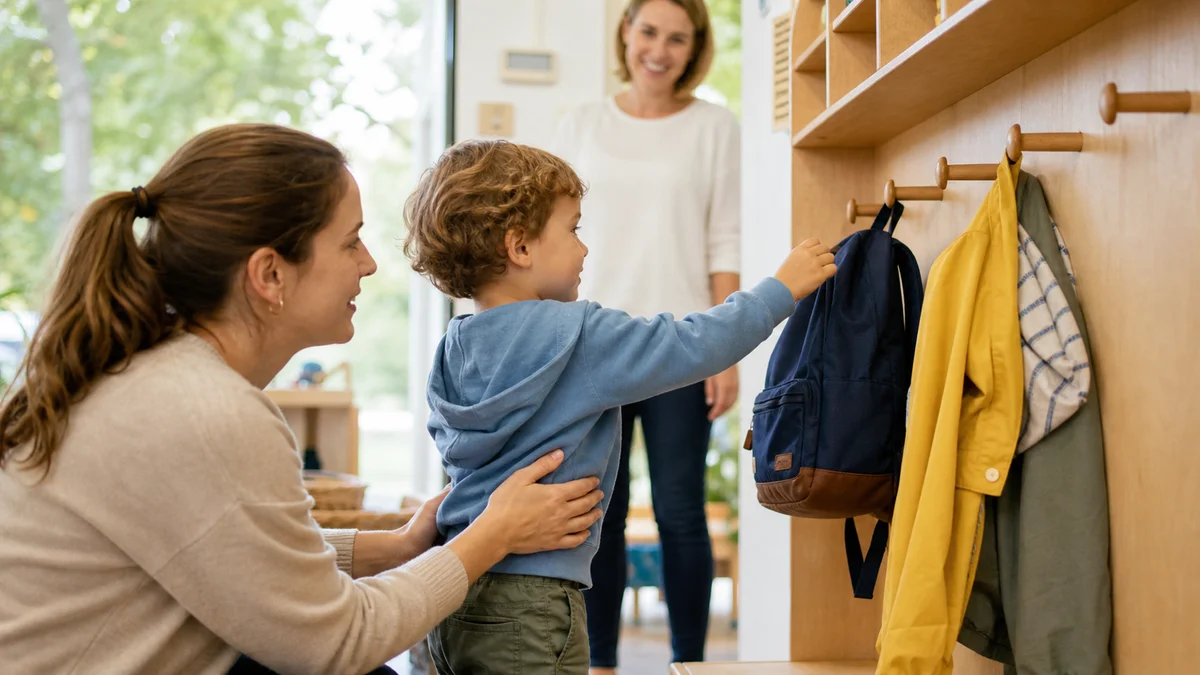
Goodbyes are often the most emotional moments. Children usually benefit from a recurring, simple ritual: hanging up their jacket, a hug, a phrase like "I will pick you up after lunch," and a clear farewell. Whether a caregiver stays with the child in the initial days or when the first separation is appropriate should be decided together with the professionals involved.
Leaving without saying goodbye can undermine trust. A straightforward farewell is better, even if it leads to tears. Tears initially indicate that the situation is significant. The educational staff can inform you about how the child calms down after the goodbye. Strive to adhere to the agreed pickup time reliably; consistency builds trust through numerous small experiences.
Acknowledge Feelings – for Both Children and Parents
Children can feel both excited and clingy. Parents may feel relieved yet guilty. Do not make these emotions a problem that needs to disappear quickly. Acknowledge them calmly: "You miss me right now. I will come back." However, avoid lengthy discussions about various worries right at the coat rack when the child is already tense.
Parents also need someone to talk to. Discuss your feelings with the caregiver, the other parent, or a trusted individual instead of displaying uncertainty in front of the child. It helps to focus on observations: What worked well? When did things get difficult? What information do we still need? This keeps the conversation solution-oriented.
Maintain a Calm Home Environment
After a day at kindergarten, many children need closeness, free playtime, and a manageable afternoon. Avoid scheduling additional appointments immediately. A snack, cuddling, outdoor activities, or a familiar evening ritual can be more beneficial than an extensive interrogation. Ask openly, "What was nice today?" and accept if the response is brief.
In the initial weeks, sleep patterns or moods may fluctuate. Observe your child and give them time. Regular routines at home provide stability without making kindergarten a constant topic of discussion. Our article on family rituals offers suggestions for small, reliable transitions between an active day and the evening.
What to Do If Separation Is Difficult?
Challenging goodbyes do not necessarily indicate that the kindergarten is unsuitable. Speak with the caregiver promptly: How is the rest of the morning going? Is there a particular moment that is especially tough? What calming strategies does the professional recommend? Together, you can adapt the next steps instead of starting from scratch every morning.
Avoid trying to rush the acclimatization process with pressure or promises of rewards. A phrase like "You need to be brave now" may be well-intentioned but offers little room for feelings. Instead, say, "You are allowed to be sad. Ms. Müller is with you, and I will come back as agreed." The exact wording should fit your family and the kindergarten.
Utilize Collaboration with the Caregiver
The caregiver observes your child in a group setting and can share valuable insights. At the same time, you know your child best outside of kindergarten. These two perspectives complement each other. Share helpful information, such as how your child prefers to be comforted or the words they use for their needs. Also, inquire about small successes: Did your child enjoy a particular area? Were they able to make contact? What eases the transition?
Open collaboration does not mean a daily evaluation of the child but rather fosters trust. Our article on flexible kindergarten models provides additional thoughts on what families should consider regarding an institution and their daily lives.
Checklist for the First Weeks
- Coordinate appointments and buffer times with the kindergarten.
- Clarify contact methods and pick-up authorizations.
- Prepare necessary clothing and hygiene items according to the kindergarten's list.
- Establish a small farewell ritual.
- Plan afternoons to be as calm as possible.
- Note observations and discuss them with the caregiver.
- Align the next steps with the child's pace and the professionals' recommendations.
Conclusion: Preparation Builds Trust, Not Perfection
Acclimatization to kindergarten is not a test that a child must pass. It is a relational experience involving the child, parents, and new caregivers. When families allocate time, share information, and create reliable goodbyes, a secure environment emerges. Small setbacks or tears are a natural part of the process. With patience and good communication, the first day will gradually evolve into a familiar routine.