
The Top 6 Evolutionary Tricycles for Babies (2026) | Buying Guide
Explore our guide on the top evolutionary tricycles for babies in 2026. Learn about their features, benefits, and how to choose the best model for your family.
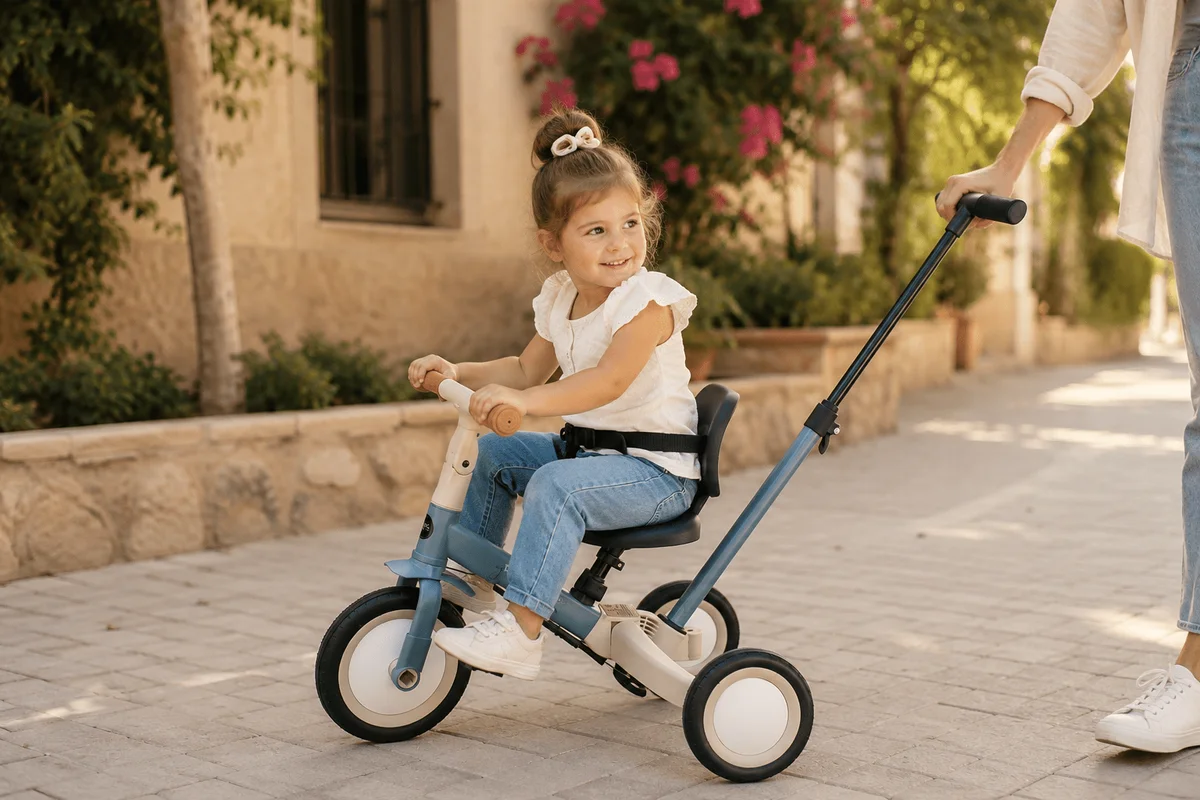
When the time comes for a baby to start exploring the world more actively, many parents wonder if investing in an evolutionary tricycle is worthwhile. In most cases, the answer is a resounding yes.
Unlike traditional tricycles, evolutionary tricycles are designed to grow with the child over several years, thanks to their various configurations. Initially, they can be used as a comfortable stroller controlled by parents through a handlebar, which is especially useful when the little one refuses to sit in a regular stroller. As the child gains independence, the tricycle gradually transforms into a fully independent vehicle.
This adaptability makes it a more economical choice compared to a standard tricycle, which might only be used for a few months.
With countless models available on the market today, not all offer the same level of quality, comfort, or ease of use. Some are noted for their compact design, others for their folding capabilities, while some prioritize safety or included accessories.
In this guide, we have selected the six most interesting current models to help you choose the one that best fits your family's needs.
In addition to a detailed analysis of each tricycle, we will address the most common questions about these children's vehicles: from what age they can be used, what features to consider before purchasing one, and the differences between an evolutionary and a traditional tricycle.
If you are looking for a comfortable, safe model that you can use for several years, you will find all the necessary information here to make a well-informed decision.
Quick Comparison of the Best Evolutionary Tricycles
| Model | Recommended Age | Foldable | Rotating Seat | Highlights | Rating | |--------------------------------|----------------|----------|---------------|----------------------------------|----------| | Kinderkraft Aston 2 Pro | 9 months-5 years | ❌ | ❌ | Best quality-price ratio | ⭐⭐⭐⭐⭐ | | Globber Explorer Trike 4 in 1 | 10 months-5 years | ✅ | ❌ | Premium finishes | ⭐⭐⭐⭐⭐ | | Smoby Baby Balade Plus | 10 months-4 years | ❌ | ❌ | Very comfortable for walks | ⭐⭐⭐⭐☆ | | QPlay Elite Platinum 6 in 1 | 10 months-5 years | ✅ | ✅ | Very complete | ⭐⭐⭐⭐⭐ | | Olmitos Gyro+ | 10 months-5 years | ✅ | ❌ | Excellent quality-price ratio | ⭐⭐⭐⭐☆ | | Twinly Sami | 10 months-5 years | ✅ | ❌ | Modern and compact design | ⭐⭐⭐⭐☆ |
Tip: If you are looking for a tricycle for regular use over several years, it is worth investing in a model made from durable materials and with a truly comfortable evolutionary system.
What is an Evolutionary Tricycle?
An evolutionary tricycle is a child’s vehicle designed to adapt to the child's growth from approximately 9 or 10 months up to 4 or 5 years. This is achieved through a system of removable accessories that are gradually taken off as the child develops balance, coordination, and independence.
In its initial stages, it functions almost like a stroller. The baby is secured with a safety harness and a protective bar, while parents completely control the direction using a rear handlebar.
As the child grows, various elements such as the footrest, canopy, backrest, handlebar, or safety bar can be progressively removed, allowing the child to pedal and steer the tricycle independently.
This evolution means that one product can be used for several years, eliminating the need to purchase a lightweight stroller and later a standalone tricycle.
For this reason, more families are opting for an evolutionary tricycle as a complement to a traditional stroller, especially when the child begins to show interest in walking and exploring their surroundings.
Indeed, many families find it an essential item, as it is used for a long time and provides great value.
At What Age Can an Evolutionary Tricycle Be Used?
While it depends on the manufacturer, most evolutionary tricycles are designed for use starting at 9 or 10 months, provided the baby can sit up steadily.
However, it’s important to note that not all stages are the same.
From 9 to 12 Months
During this phase, the tricycle is used primarily as a stroller. The baby does not pedal or steer the vehicle. Parents fully control the ride through the handlebar while the little one travels comfortably secured by the harness and protected by the front bar.
It is crucial that the seat offers good back support and that the footrest allows the legs to rest properly.
From 12 to 24 Months
After the first year, children become interested in moving the pedals and actively participating in the ride. Although they still do not fully control the steering, they enjoy feeling like they are a part of the journey.
During this stage, models with free-wheel pedals are particularly useful, as they allow the child to move their legs without interfering with the parents' steering.
From 2 to 3 Years
This is the time when most children can start pedaling on their own.
At this stage, some accessories can be removed, increasing their autonomy and promoting the development of coordination and balance.
From 3 Years On
Many children now use the tricycle almost as an independent vehicle.
Only those elements necessary for comfort and safety remain, while the child gains confidence before transitioning to a balance bike or a pedal bike.
Why Are More Families Buying Evolutionary Tricycles?
A few years ago, it was common to purchase a traditional tricycle when a child turned two or three. However, the introduction of evolutionary models has completely changed this trend. Their main advantage is that they allow families to utilize a single product for a much longer period, adapting to various stages of child development.
But that’s not the only reason for their growing popularity.
They Accompany the Child's Growth
One of the biggest attractions of evolutionary tricycles is their ability to transform as the child grows.
Instead of becoming obsolete after a few months, the same tricycle offers different configurations that adapt to the child's age and capabilities. This not only represents significant economic savings but also makes for a much more practical purchase for families.
They Promote Psychomotor Development
Riding a tricycle helps improve coordination between arms and legs, strengthens the muscles of the lower limbs, and stimulates balance.
Moreover, starting as a passenger and transitioning to driving the tricycle encourages a gradual and safe evolution.
They Are a Fun Alternative to Strollers
Many children reach a point where they reject the stroller because they want to feel more independent. The evolutionary tricycle allows them to continue enjoying long walks with the safety of a retention system while providing a much more engaging and enjoyable experience.
Greater Convenience for Parents
Thanks to the directional handlebar, parents can easily control the route without needing the child to have experience handling the tricycle. In higher-quality models, the ride is surprisingly smooth even on cobblestones, parks, or dirt paths.
How to Choose the Best Evolutionary Tricycle for Your Baby
Choosing an evolutionary tricycle may seem straightforward at first glance, but as you start comparing models, you’ll discover significant differences in safety, comfort, materials, and usability.
While all serve the same basic function, not all provide the same experience for the child or the parents. Before making a decision, consider several aspects that will make a difference over the coming years of use.
1. Recommended Age and Evolutionary Stages
First, check the age range for which the tricycle can be used and how long it is designed to accompany the child. The best models can be used from 9 or 10 months and continue to be utilized until 5 years, adapting to different developmental phases with removable accessories.
The more evolutionary stages it offers, the longer it can be used, making your investment more worthwhile.
2. Safety: The Most Important Aspect
Safety should always be the top priority. A good evolutionary tricycle must include a five-point harness, a sturdy protective bar, and a braking system that prevents accidental movement when stationary.
It is also advisable that the wheels provide good traction and that the structure remains stable even when the child moves or leans to one side.
3. Comfort for the Child
If you plan to use the tricycle for long walks, comfort will make a significant difference. Look for features such as seat padding, backrest height, a wide footrest, a canopy with good sun protection, and a reclining system if the model includes it.
A comfortable child will enjoy the ride much more and will be less likely to want to get off constantly.
4. Ease of Handling for Parents
The handlebar should provide good directional feedback and allow smooth movement of the tricycle, even when the child isn’t cooperating yet. It’s also worth checking the turning radius, the total weight of the tricycle, and how easy it is to disassemble or fold its various components.
5. Type of Wheels
Wheels are one of the elements that most influence the user experience. Models with EVA or pneumatic wheels tend to offer a quieter, more comfortable, and stable ride than those with hard plastic wheels.
If you plan to use the tricycle in both urban settings and parks or trails, it’s worth investing in a model with higher-quality wheels.
6. Folding and Storage
If you have limited space at home or travel frequently by car, a foldable tricycle can be much more practical. Not all models offer this option, so it’s essential to check their dimensions when folded and the time it takes to store them.
7. Included Accessories
Some tricycles come with very useful extras, such as a storage bag, rear basket, bottle holder, extendable canopy, adjustable footrest, or even a rotating seat. While these aren’t essential, these details can make daily use more comfortable for both parents and the child.
In this section, we delve into three of the most interesting and popular evolutionary tricycles currently available on Amazon. We evaluate aspects such as material quality, comfort, ease of driving, safety, versatility, and value for money to help you choose the model that best fits your family's needs.
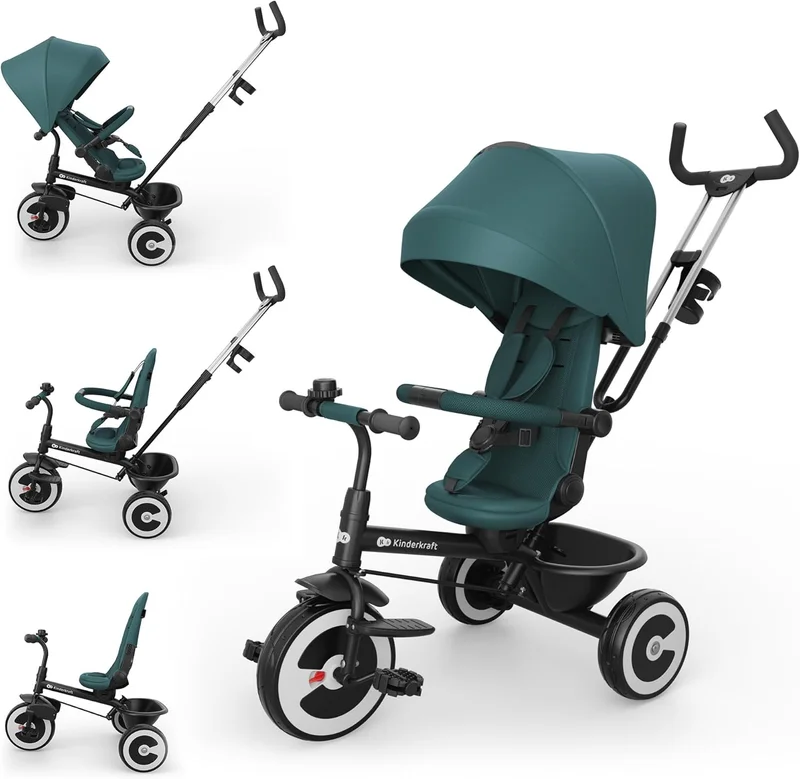
1. Kinderkraft Aston 2 Pro: The Best Quality-Price Evolutionary Tricycle
Our Rating: ⭐⭐⭐⭐⭐ (9.8/10)
Ideal for: Families looking for a robust, comfortable, and durable tricycle without overspending.
💛 VIEW PRICE ON AMAZON
Main Features
- Recommended Age: 9 months to 5 years.
- Five-point safety harness.
- Removable protective bar.
- Adjustable parental handlebar.
- EVA puncture-resistant wheels.
- Removable footrest.
- Wide canopy with sun protection.
- Rear basket and storage bag.
- Pedals with free-wheel function.
- Sturdy and stable structure.
This model stands out for its balance between price and features, making it a top choice for families seeking durability and comfort.