
How to Choose the Right Bottle for Your Baby
Discover how to choose the right bottle for your baby, focusing on mixed feeding strategies and practical tips to ensure a successful breastfeeding experience.

Navigating the world of parenting can be complex, especially when it comes to feeding your baby. If you are breastfeeding and considering introducing a bottle, it's important to understand that there is no single path to follow. Families adapt, babies change their rhythms, and each day presents new challenges. In this context, a bottle is not a symbol of failure; rather, it is a tool that should be chosen wisely.
In this article, we will explore mixed feeding with a bottle and how to select a suitable bottle that allows you to nourish your baby without turning each feeding into a battle with guilt!
Mixed Feeding: Why a Bottle Can Be a Smart Choice (and Not a Defeat)
Mixed feeding involves alternating between breast and bottle, providing expressed breast milk, formula, or both. This approach is not a lesser form of feeding; for many families, it is a sustainable solution over time.
There are several practical reasons why a bottle can be beneficial even when breast milk is available: returning to work, the need for rest, frequent feedings, temporary latch difficulties, involving the other parent, twin births, prematurity, temporary drops in supply, or simply the desire to lighten the maternal load without completely stopping breastfeeding.
The key point is that when a bottle is introduced into a breastfeeding routine, its role is not to “replace” the breast. Instead, it should not interfere with how the baby sucks and manages milk from the breast.
Breastfeeding requires the baby to:
- latch properly
- use their tongue and jaw
- create suction
- regulate their rhythm
- pause for breath
- resume feeding
This is an active, coordinated effort that shapes their feeding style. In contrast, some bottles allow milk to flow too quickly, making the feeding experience much easier and faster, which can lead to challenges.
What Makes a Good Bottle for Successful Mixed Feeding?
A well-chosen bottle aims to mimic the breastfeeding experience as closely as possible, especially in terms of rhythm. This involves three crucial characteristics:
- It should promote active sucking; the baby needs to work with their mouth and tongue, rather than merely swallowing because the milk flows freely.
- It must allow for controllable flow; ideally, the baby can pause, breathe, and resume without the nipple leaking or pushing milk continuously.
- It should help reduce air intake; a design that does not take this into account can negatively impact feeding.
Technical Features to Consider Before Buying a Bottle
You might be wondering, “That’s all well and good, but what should I actually look for in a good bottle?”
The answer is that there are specific features to pay attention to; not all bottles are created equal.
- The nipple is as important as the bottle itself. It is the part that goes into the baby’s mouth: its shape, softness, base, length, and adaptability to sucking all matter. If the nipple is too rigid, some babies struggle. If it’s too soft, sucking can become frustrating.
- Flow rate is a significant choice, not a detail. For mixed feeding, starting with a slow flow is often advisable, even if the baby is not a newborn. This is to ensure that the bottle does not become an easy shortcut. If feedings take too long or the baby falls asleep quickly, adjustments can be made later.
- The anti-colic system should be functional. Don’t just rely on marketing claims; assess whether the bottle genuinely has a mechanism that compensates for suction vacuum, allowing air to stay separate from the milk.
- Material quality matters. Whether it’s glass, plastic, or silicone, each has its pros and cons (weight, durability, ease of handling). The real question is: “Will I be able to clean and use this bottle without too much hassle?” A complicated bottle often ends up being used less frequently.
Choosing the Right Bottle Based on Your Baby
There is no single best bottle; instead, there is the best bottle for each baby at that stage, with that type of feeding.
If your baby is very eager to feed, a controlled flow and a slower feeding pace may be necessary. Conversely, if they tend to fall asleep quickly and struggle to maintain sucking, a softer nipple might help support their latch without making it difficult to get milk.
If your baby experiences a lot of spit-up, it’s wise to consult your pediatrician about the underlying causes and also consider posture and rhythm, selecting a bottle designed for anti-regurgitation.
In any case, when facing issues with bottle use, there is a golden rule that can simplify understanding the problem: change only one thing at a time. If you change the nipple, flow, posture, and timing all at once, it will be much harder to identify what worked.
Introducing the Bottle Without Sabotaging Breastfeeding
The “how” is almost as important as the “what.” For many families, the transition becomes complicated not because the bottle is wrong, but because it is used at a completely different rhythm than breastfeeding.
Here, responsive feeding comes into play: this means offering the bottle while respecting the baby's timing and cues, without pressuring them to finish, and allowing for natural pauses. Essentially, the parent guides the situation, but the baby dictates the pace.
In general, it is beneficial to ensure that:
- the baby is in a semi-upright position (not lying back)
- the nipple is always full of milk, with the bottle held at a 90-degree angle to the baby’s head
- intentional pauses are included, similar to breastfeeding
- attention is paid to satiety cues (turning their head, slowing down, letting go of the nipple)
If the goal is to achieve mixed feeding, introducing a bottle that “forces milk” is often the quickest way to create chaos: short feedings, air intake, constant demands for milk, and frustration with breast feeding.
Navigating Products on the Market: What to Consider Before Choosing a Specific Model
The question to ask when selecting the right bottle for your needs is: “Will this bottle help me achieve feedings that are more similar to breastfeeding in terms of rhythm, control, and comfort?”
Then, compare models based on four concrete criteria:
- nipple: does the shape and design meet the needs of a developing oral cavity?
- available flows: is there a truly slow option? Are replacements easy to find?
- air management: is the system clear, easy to clean, and functional?
- practicality: will you use it at 3 a.m. without frustration?
If you can answer “yes” to each of these questions, congratulations: you have likely found the most suitable bottle for your baby’s needs!
If you’re looking for suggestions on models that we believe comprehensively meet the outlined needs, here are three options that can truly make a difference in successful mixed feeding.
Chicco Perfect 5: The Bottle That Adapts to Your Baby’s Sucking Rhythm

Chicco Perfect 5 is designed to function bio-functionally, meaning it automatically adapts to the sucking rhythm, intensity, and pauses of each baby. The heart of the system is the Intui-Flow, which combines the Physio nipple with the Equilibrium membrane: the nipple supports the natural wave-like movement of the tongue while the membrane allows air into the bottle without mixing with the milk, preventing vacuum and maintaining a steady flow. This enables the baby to drink regularly without being overwhelmed by milk and without having to “fight” for it to flow, reducing air intake, spit-ups, and irritability. It is particularly interesting for mixed feeding because it does not impose an artificial rhythm but follows the baby’s physiological pace, just like breastfeeding.
MAM Easy Start: The Anti-Colic Bottle Designed for Natural Mixed Feeding

MAM Easy Start is designed to support the initial bottle feedings without disrupting the breastfeeding experience. Its SkinSoft silicone nipple, soft and flattened, is designed to mimic the feel of the nipple during breastfeeding, facilitating acceptance even in very young babies. The anti-colic system with a valve at the base reduces air bubbles in the milk, helping the baby to drink more steadily and calmly, with less air intake. This results in more relaxed feedings and a lower likelihood of colic and spit-up. For those embarking on a mixed feeding journey, it is a straightforward bottle that aligns with physiological sucking and is practical for daily use, thanks to its self-sterilizing feature in the microwave, which simplifies feeding organization on the go.
Suavinex Zero Zero: The Bottle That Mimics Breast Function to Reduce Nipple Confusion
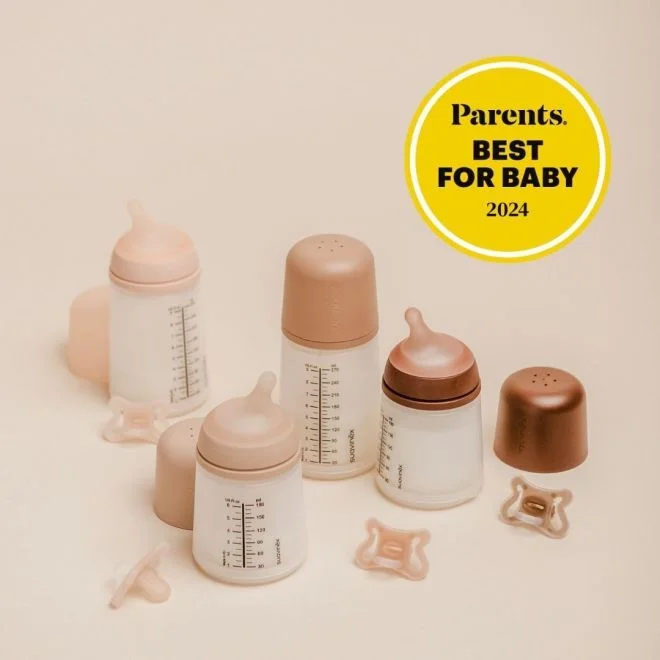
Suavinex Zero Zero is specifically designed for those who want to combine breast and bottle without compromising breastfeeding. Its system with an internal silicone bag contracts as the baby sucks, just like mammary glands do, preventing air from entering and maintaining the milk at the right pressure. The adaptable flow nipple allows more or less milk to pass based on the baby’s sucking strength, replicating the behavior of the breast: the baby has to work to get the milk and can manage their own rhythm. This helps reduce nipple confusion, making the transition more natural for both newborns and older babies alternating between the two feeding methods. It is particularly suitable for mixed feeding from the early days, even for those with weak sucking or prematurity.
Remember: the key to successful mixed feeding lies in thoughtful selection and introduction of the bottle to ensure a smooth experience for both you and your baby.