
Guilt After a Cesarean: Why You Truly Gave Birth
Guilt after a cesarean affects many mothers. Discover why this feeling is common, how to ease it, and why a cesarean is still a true birth.


The guilt after a cesarean, you know it: it’s that little voice that whispers to you that you didn’t "really" give birth. That your body didn’t "know how". That other mothers experienced the "real" thing, and not you. You had a cesarean, and instead of feeling just relieved and happy, you carry this feeling in silence, like a somewhat shameful secret.
So let’s set the record straight right away: you gave birth. Period. And this guilt you feel is understandable — but it is based on a misconception. Let’s untangle this together.
You Are Far from Being an Isolated Case


The first thing to know to break free from the impression of having "failed" where others succeeded: cesarean sections are anything but rare. In France, about one in five women gives birth by cesarean, which is around 20% of births. One in five. In a PMI waiting room, in your group of mom friends, around you, many have gone through the operating room.
This is not a shameful detour. It’s a way to bring your child into the world, practiced hundreds of thousands of times a year, most often for a good medical reason: a baby in distress, labor that isn’t progressing, a risk to you. A cesarean is not the opposite of giving birth. It is giving birth.
Where Does the Guilt After a Cesarean Really Come From?


If you feel guilty, it’s not because you did something wrong. It’s because you were sold, like all of us, a very specific image of "the" birth: labor, contractions, pushing, the baby placed on your belly in the moment. When reality doesn’t match that film, the brain interprets the gap as a personal failure.
Psychologist Nathalie Parent, co-author of a book on postpartum, explains that these feelings of shame and disappointment are deeply linked to the desire to be "an ideal mother," as if one must absolutely experience a perfect pregnancy and birth to deserve that status. Spoiler: the perfect mother does not exist, and it is not the way your baby came into the world that determines your worth.
Hurtful Comments from Others


There is also a factor that is rarely discussed: the remarks from others. "So, did you give birth naturally?", "Oh, you didn’t experience the real birth then", "At least you didn’t suffer". These little phrases, often thrown out without malice, reopen the wound every time.
Professor Jacky Nizard, a gynecologist-obstetrician at Pitié-Salpêtrière, aptly describes this internalized guilt in some of his patients and the real psychological damage it can cause. You have the right to respond, or simply to protect yourself from these comments. What others think of "your" way of giving birth is none of their business.
Cesarean: What Your Body Really Went Through
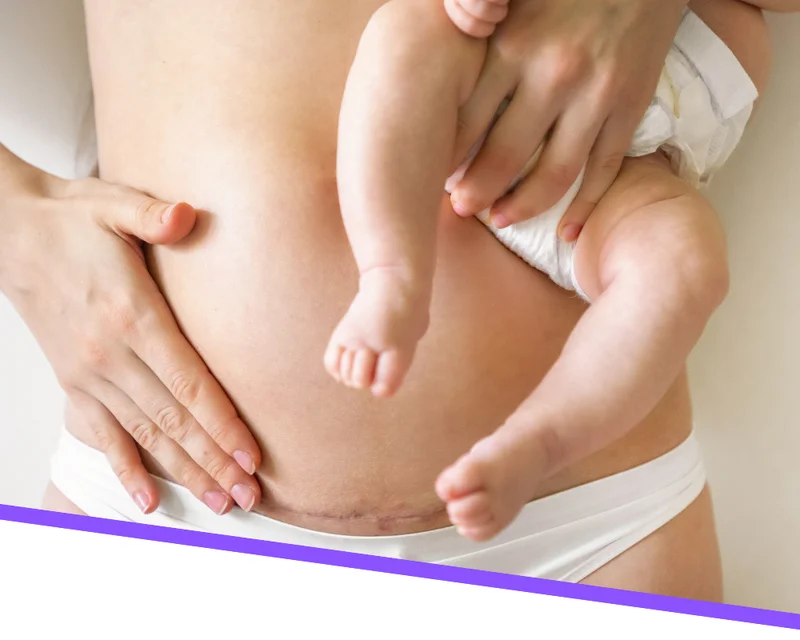

Sometimes we hear that a cesarean is the "easy way out." It’s exactly the opposite. You underwent a major surgical procedure, often in an emergency, in the cold of an operating room, sometimes separated from your partner, with anesthesia that disconnects you from half of your body. Then you managed a scar, a long and painful recovery — all while taking care of a newborn.
If the bond with your baby took a little time to form because you didn’t feel them being born or welcomed them in the moment, it’s a known and documented reaction, not proof that you are a "bad mother." This bond is built day by day. It has no deadline.
How to Alleviate Guilt After a Cesarean

You are not obligated to deal with this alone, and you don’t have to "suck it up" indefinitely. Here are some tips that can really help:
- Put it into words. Telling your birth story, even long after, can diffuse a lot of things. To your partner, to a trusted friend, or to a professional.
- Talk to your midwife. In a postnatal consultation, she can explain to you precisely why the cesarean was necessary. Understanding the "why" often brings a lot of peace.
- Don’t hesitate to see a perinatal psychologist. If guilt is eating you up, preventing you from enjoying your baby, or is accompanied by great sadness, it’s not a luxury, it’s real care.
- Find other cesarean moms. Organizations like Césarine bring together women who have experienced exactly that. Feeling understood changes everything.

And if one day you want another child, know that vaginal birth after cesarean (VBAC) is often possible, with a success rate estimated between 60 and 80%. But that will be your choice, not a revenge to take on yourself.
You carried your child for nine months. You brought them into the world. You care for them every day. That is giving birth. The rest is just noise.