
Master Makatsu & Biddle: AMIGO Games Reviewed
Discover the exciting family games Master Makatsu and Biddle from AMIGO, perfect for holiday fun and gifts for all ages.
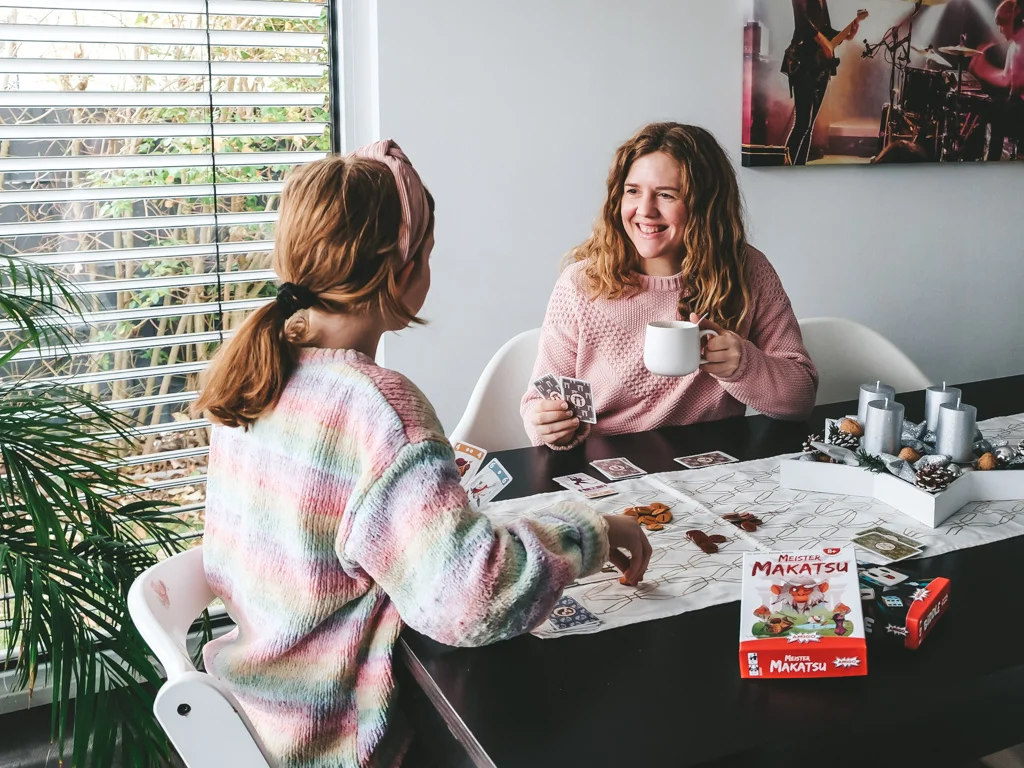
Christmas is approaching quickly! If you are looking for great family games for the holidays that make perfect Christmas gifts for children or adults, then you should keep reading! Because AMIGO has released some fantastic new games this fall, and we enthusiastically tested two of them: Master Makatsu and Biddle. These games are perfect for cozy winter days. When we come home in the afternoon, as it gets dark outside and we light the candles on the Advent wreath, I often hear: "Mom, can we play a round?"
Great Family Games for Young and Old from AMIGO
December is often hectic and full of appointments. That’s why we consciously take time to pause and sit together comfortably. I love these quiet (and screen-free!) moments during the Christmas season. And what better way to spend time together than playing games and simply shutting out the everyday hustle and bustle?
We couldn’t resist testing two very special new releases from AMIGO that have been available since September: Master Makatsu, a tactical ninja card game, and the exciting dice game Biddle. They make great small gifts for the Nikolaus boot or under the Christmas tree! You can try them out as a family or with friends during the holidays.
AMIGO has really good family games that have accompanied us for many years. With their brilliant game ideas and simple rules, they are fun for the whole family. The AMIGO game Burger Slam, which joined us last year, is still one of my daughter’s absolute favorite games.
The New Game Master Makatsu from AMIGO: Card Game with Ninja Flair
Master Makatsu has immediately captivated us with its fun and original ninja-themed illustrations. The rules of this card game by successful author Reiner Knizia are quickly learned, so you don’t have to study the instructions for long before you can start playing. Nevertheless, the game is a lot of fun! With children, a practice round is always a good idea, where everyone plays with open cards to understand the principle. It is suitable for two to six players aged eight and up, and a game round lasts about 30 minutes on average.
What is it About?
In Master Makatsu, players compete as ninjas to impress the famous master Master Makatsu. In three game rounds with varying numbers of rounds, you must prove your skills. Here, good timing, tactics, and concentration are crucial. The goal of the game is to pass the tests in the dojo and to receive as few minus points as possible.
How to Play Master Makatsu (for the explanation video)
- At the beginning, each player receives their own deck of 24 cards (the numbers 1–8 in three colors).
- You play a total of three rounds with varying numbers of rounds.
- In each round, you draw four cards from your deck, look at them, and play two of them. The other two cards are set aside for later, as you will need them for rounds 2 and 3.
- After each player has played their two cards, the cards are compared. First, you look at all the blue cards, then all the yellow, and finally all the purple cards.
- And now it gets exciting! The player who played the highest card of a color receives minus point chips. The number of minus point chips you receive is indicated on your card. If two players have played a card of the same color and value, the player who played the card last receives the minus point.
- The minus point chips you distribute differ in the three rounds of the game. In the first round, you distribute the chips with one minus point printed on them, in the second round the chips with two minus points, and in the third round the chips with three minus points. Here, some tactics are required. Will you play your high cards at the beginning of the game to perhaps receive fewer minus points in rounds two and three? And what strategy are the other players pursuing?
- The player who played the purple card with the highest value receives Master Makatsu and gets to start in the next round. The cards you played in this round are removed from the game, and you draw four cards from your pile for the next round.
- When your deck is exhausted, the first round is over, and you begin with the second round. For this, you now use the cards you previously set aside. Make sure to shuffle them before continuing. Now you play again as in round one, trying to receive as few minus points as possible. But don’t forget: now the chips with two minus points are distributed.
- With the cards you set aside in the second round, the third and final round is played. Since only a few cards are left, you will play only a few rounds and must pay close attention, because now the highest card value receives chips with three minus points! The last two cards you have in hand are removed from the game, and the game ends.
- Now you count your minus point chips. The player with the fewest minus points wins the game.
What We Like About Master Makatsu:
- Quick to explain and immediately playable
- Exciting for both children and adults
- Short rounds, making it perfect for quick play
- Surprisingly strategic
- Suitable for larger groups of up to six players
- Fun illustrations
AMIGO Biddle: Turbulent Dice Game for the Whole Family
While Master Makatsu is more strategic and calm, Biddle is the complete opposite. In this fun and turbulent dice game for ages 8 and up, you must prove your gambling talent. The game is suitable for two to five players, and a game round lasts about 30 minutes. So it’s great for a fun and relaxed game round in between.
What is it About?
All players try to complete a dice task, e.g., rolling three 3s and three 4s or reaching a certain sum. The big question is: "How many rolls do you need for that? 10? 6? 5? Or just 3?"
In the bidding phase, you underbid each other until two teams form: One team that takes on the dice challenge and one team that bets against it. My daughter laughed so hard when I was once again too bold and then spectacularly failed.
How to Play Biddle (for the explanation video)
- Set up the tableau and place it with the six dice in the center of the table. Each player chooses a color and takes the ten game pieces of their color. Place one of your pieces on the start bar of the tableau.
- Shuffle the 55 cards with the dice tasks and place them as a face-down stack. Flip the top card. This is your first dice task. The tasks are also explained on a small overview that you should have handy.
- Each round consists of a bidding phase and a dice phase.
- First, the bidding phase starts: Each player thinks about how many dice attempts they need to complete the dice task. The next player in turn can either go along with this bet, underbid it, or drop out.
- This continues until all game pieces are on the same field and at least one player has dropped out. This ends the bidding phase and the dice phase begins. Note: If you are playing with two players, you underbid each other until one drops out.
- Now all players who have not dropped out must roll the dice. Try to achieve the dice task with the number of rolls you bid. It doesn’t matter if only one person rolls or if you take turns.
- If you complete the task, you move your game piece to the right on the score track and receive points. With each round, the points you can achieve increase.
- If you overbet and do not complete the dice task, the other team that bet against you receives the points.
- After ten rounds, the game ends, and the player with the most points wins the game.
Why We Like Biddle:
- Quick game setup
- Very interactive
- Fast, exciting rounds
- Perfect mix of luck and strategy
- Sometimes cooperative play