Heat Stroke in Babies and Children: Fever, Irritability... 4 Signs of Dehydration During a Heatwave (and Not Just Fatigue)
Heat strokes can occur rapidly, especially during a heatwave. Babies and children are fragile individuals, so it is important to protect them well and take certain precautions. Here are the signs of heat strokes and actions to prevent hyperthermia.

Heat strokes can occur rapidly, especially during a heatwave. Babies and children are vulnerable individuals, so it is important to protect them well and take certain precautions. Here are the signs of heat strokes and actions to prevent hyperthermia.
Children are particularly susceptible to certain illnesses, and it is important to know how to identify them. They are among the "fragile" individuals who need to be protected, especially during periods of extreme heat. The heatwave makes children particularly vulnerable. Therefore, it is necessary to know how to act during high temperatures: how to relieve them at night, what to feed them... to ensure these periods pass as smoothly as possible and to prevent heat strokes.
Prolonged exposure to the sun or lack of hydration can indeed be fatal for fragile individuals. During a heatwave, there are several signs to watch for and actions to adopt to protect your child.
How to Know if Your Baby Has Suffered from Heat Stroke?
Heat strokes in infants and children occur due to prolonged exposure to the sun. It can also appear if they stay too long in an overheated or poorly ventilated place. Therefore, it is possible to suffer from heat stroke even indoors.
One of the first symptoms is an elevation in body temperature, thus the onset of fever. The child may also change behavior and seem a bit “groggy”.
 © shutterstock
What Are the 4 Warning Signs of Heat Strokes?
Heat stroke is easily detectable in a child. Although younger children cannot express feelings of thirst, the impact of excessive heat can be detected through various symptoms:
- The child can quickly develop a high fever, reaching up to 40 degrees. Their skin reddens easily and dries out.
- They may also exhibit behavioral changes, such as intense fatigue or, conversely, a state of hyperactivity. It is common for the child to become cranky and for dark circles to appear under their eyes.
- When suffering from heat stroke, the child may experience intense headaches. This is usually followed by nausea or vomiting, as well as an increased heart rate.
- In extreme cases, the child may experience dizziness or even neurological signs such as confusion, convulsions, or loss of consciousness.
Following a heat stroke, the child can become dehydrated very quickly. Their mouth and lips become dry, and their urine is more concentrated and therefore darker. So stay vigilant and keep your children well-hydrated. And in case of doubt, do not hesitate to consult a healthcare professional.
What to Do If Your Baby Suffers from Heat Stroke?
If your baby shows certain signs of heat stroke, here are the actions to take:
- Undress your baby
- Place them in a damp cloth, but not too cold. This will help them cool down.
- Set your child in a cool, well-ventilated room. You can also close the shutters.
- Monitor that their temperature decreases.
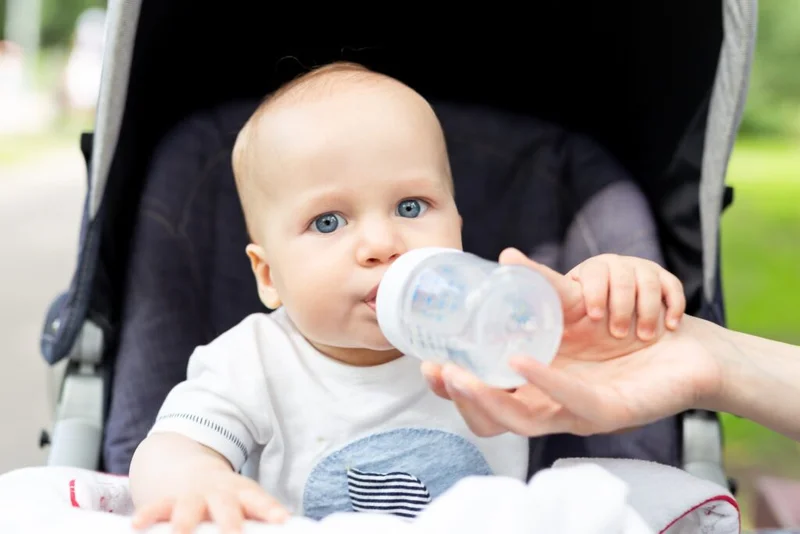
- Ensure they do not become dehydrated and give your baby regular drinks, even if they do not ask for it. However, the water should not be too cold to avoid the risk of thermal shock. You can also use an oral rehydration solution.
If your baby's temperature decreases too slowly or if symptoms persist, call emergency services (15).
 Heat Stroke in Babies and Children: Fever, Irritability... 4 Signs of Dehydration During a Heatwave (and Not Just Fatigue)
How to Prevent Heat Stroke in Children and Infants?
In summer, heat strokes can happen very quickly. Here are some simple actions to limit this phenomenon.
- Monitor the time and hours of exposure, especially between 12 PM and 4 PM. This is when the sun is highest in the sky and the UV index is the highest. Be careful, clouds do not prevent UV rays from passing through. An infant under one year old should not be exposed to the sun at any time of day.
- Protect your child: they should wear a t-shirt, a cap, and sunglasses. Opt for lightweight clothing to prevent overheating. Prefer a loose t-shirt in light colors and shorts rather than a bodysuit or just a diaper for indoors.
- Apply sunscreen with an SPF of 50. If they go into the water, reapply every two hours.
- Ensure your child stays well-hydrated. Make them drink regularly, even if they do not ask for it. A child, especially an infant, can become dehydrated very quickly.
- Be cautious of heat strokes in the car. Prefer short trips and avoid long journeys in the middle of the afternoon. Remember to stop every 2 hours to take the baby out of the car, place them on a blanket in the shade, and refresh the air in the cabin. Never leave a child alone in a car, even parked in the shade.
- Try to stay in cool places. Ventilate your home in the morning when it is not too hot and keep the shutters closed to maintain coolness.