
Solar Power Solutions for Families: Smart Ways to Reduce Energy Costs
As energy costs rise, families can benefit from balcony power plants, which provide solar energy for household needs, helping to reduce monthly bills. This guide explores sizes, benefits, and considerations for families.
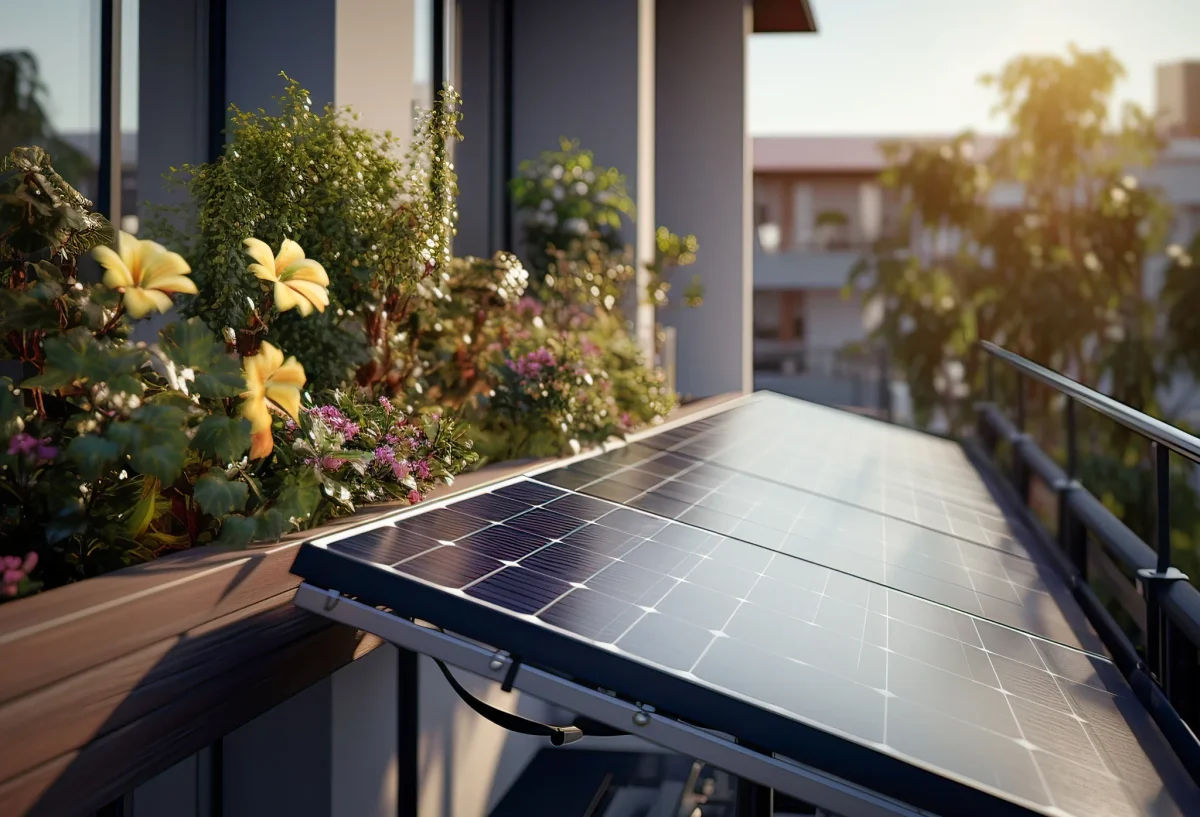
As energy prices continue to rise, families are feeling the pinch more than ever. One innovative solution gaining traction is the balcony power plant, which harnesses solar energy to power household appliances such as refrigerators and washing machines, effectively lowering monthly utility bills. For households with higher energy consumption, a 2000-watt setup with storage is recommended, while many others may find an 800-watt system to be a solid starting point. Companies like Tepto offer ready-to-use complete sets with high-quality components that can be expanded as needed.
Living with children often means dealing with higher energy bills. Appliances like dishwashers, washing machines, dryers, refrigerators, freezers, gaming consoles, and laptops for homework contribute significantly to a family's energy consumption. This is where a balcony power plant can make a difference. These compact, plug-and-play solar systems can typically be self-installed and registered, providing a portion of your energy needs directly from solar power. This guide outlines which size is appropriate for different family needs and what to consider when purchasing.
Benefits of a Balcony Power Plant for Energy Savings
A balcony power plant consists of one to four solar panels and an inverter, connected to an outdoor socket. The generated electricity first powers your home, with devices like refrigerators, routers, heating pumps, and standby appliances drawing energy directly from the solar source instead of the grid. This process, known as self-consumption, can significantly reduce your family's energy bill.
The math is straightforward but compelling: assuming an electricity price of 30 to 40 cents per kWh, every kilowatt-hour of solar energy consumed directly translates to savings. An optimally positioned 800-watt balcony power plant can generate approximately 700 to 900 kilowatt-hours annually, depending on location, orientation, and shading. If your family utilizes a significant portion of this energy, you could see savings in the lower to mid three-digit euro range over the year. While results may vary based on weather, orientation, and consumption habits, the trend is clear. Adding a larger system with storage, such as a 2000-watt balcony power plant, can further enhance self-consumption, especially in households with evening activities.
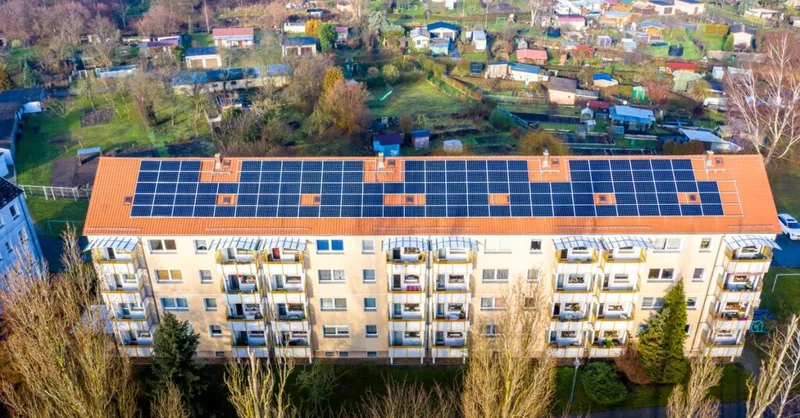
For families, this is particularly appealing since many essential appliances run continuously. Refrigerators operate around the clock, routers stay on, and heating systems require power. When the sun is shining, your balcony power plant can cover this baseline load without any additional effort.
Choosing the Right Size for Your Family
Determining the right size for a balcony power plant depends on two key questions: What is your annual energy consumption, and how much space do you have for the panels? A typical family of four consumes several thousand kilowatt-hours per year, particularly if they have a heat pump or electric vehicle. Additionally, the physical setup, such as balcony railings, terrace roofs, garage roofs, carports, or garden space, will influence your options.
Power Classes: 400 / 800 / 2000 W
Balcony power plants are categorized by two figures: the maximum feed-in power of the inverter and the installed module capacity in watt-peak (Wp). The feed-in to the home grid for plug-and-play solar devices is capped at 800 watts, which can be implemented without special permission from the network operator. The total module output can exceed this, often reaching around 2000 Wp. This might seem contradictory, but it’s beneficial: stronger modules yield more energy even in diffuse light, during winter, and under unfavorable conditions, as the inverter can operate close to its 800-watt limit for longer periods.
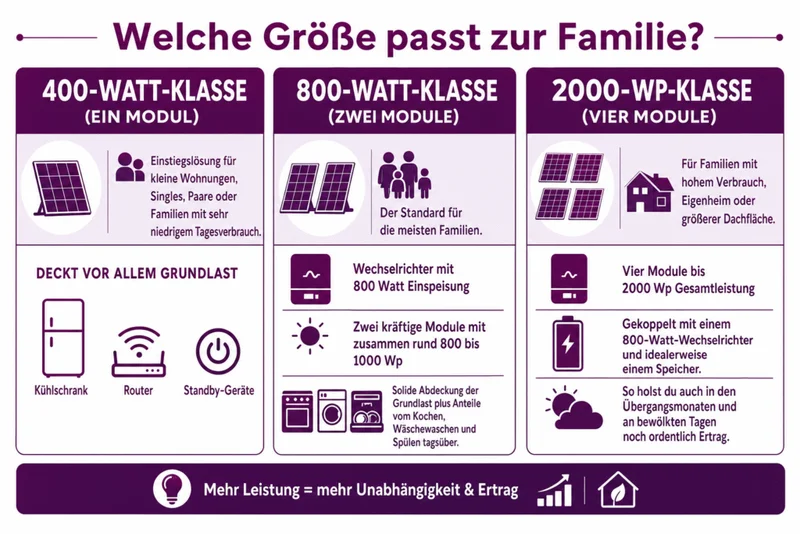
- 400-Watt Class (one module): An entry-level solution for small apartments, singles, couples, or families with very low daily consumption. Primarily covers the basic load like refrigerators, routers, and standby devices.
- 800-Watt Class (two modules): The standard for many families. Inverters with 800 watts of feed-in capacity, paired with two robust modules totaling around 800 to 1000 Wp. Effectively covers basic loads plus some daytime cooking, laundry, and dishwashing.
- 2000-Wp Class (four modules): Suitable for families with high consumption, homeowners, or those with larger roof areas. Four modules can provide up to 2000 Wp total output, combined with an 800-watt inverter and ideally a storage solution, ensuring substantial energy yields even during transitional months and cloudy days.
It’s important to note that “800-watt modules” are not standard products. When referring to 800 watts, it typically relates to the inverter limit, while module capacity is expressed in watt-peak and usually ranges from 400 to 500 Wp per module.
With or Without Storage?
Without storage, solar energy flows directly into the home grid. What is consumed is saved, while any excess typically goes unused into the public grid, often without compensation for plug-and-play systems. This is where storage becomes crucial. It stores surplus energy generated during the day and releases it at night, when families usually cook, do laundry, watch TV, or run dishwashers.
For families with high evening consumption, a balcony power plant with storage can make a significant difference in energy bills. Conversely, those who are home during the day and consume much of their energy during sunlight hours may find a system without storage sufficient. Thus, storage is not mandatory but depends on your consumption profile and budget.
When Is a 2000-Watt Set with Storage Worth It?
A 2000-watt set with storage is particularly beneficial for families with high energy needs and available space. Four modules can generate enough power even in winter and under diffuse light, allowing the 800-watt inverter to operate near its limit for extended periods. This increases the annual yield compared to a standard 800-watt setup with two modules. When combined with storage, more kilowatt-hours can be consumed directly.
This type of system is especially advantageous when three factors align:
- High household energy consumption due to large appliances, home office use, multiple children, or a heat pump.
- Sufficient space for four modules, such as on a carport, garage roof, flat roof, or garden installation.
- Significant evening consumption, typical of family activities in the late afternoon and evening.
Tepto’s 2000-watt sets with four modules provide enough power to noticeably reduce typical family energy usage. Their range includes both sets with Trina modules and Hoymiles inverters, as well as options featuring the FoxESS Avocado 22 Pro, which combines storage and inverter in one device. Families looking to remain flexible can start with an 800-watt set and later upgrade to four modules with storage, provided the components are compatible.
The following table can help you assess which power class suits your household:
| Household | Recommended Power Class | Is Storage Worth It? | |-----------|------------------------|-----------------------| | Small apartment, 1-2 people, low consumption | 400-800 watts, 1-2 modules | Usually no, unless evening consumption is high | | Family in a row house, 3-4 people, moderate consumption | 800 watts with 2 strong modules or 4 modules up to 2000 Wp | Worth it if heavy evening usage | | Large home, family with heat pump/electric vehicle, high consumption | 2000 Wp with 4 modules | Generally recommended |
Key Considerations When Buying
A balcony power plant is an investment meant to last many years. Thus, the quality of components and the service provided by the supplier are more critical than minor price differences. Pay particular attention to the following:
- Brand Components: Inverters from established manufacturers like Hoymiles and modules from well-known brands like Trina are typically well-documented and readily available for service.
- Warranty: Long product warranties on modules and inverters are a good sign; check the specific terms in the data sheet of each set.
- Complete Package: A set that includes everything needed—modules, inverter, mounting, cables, Schuko connection, and optional storage—saves you the hassle of sourcing components and avoids compatibility issues.
- Consultation: A provider that advises you on orientation, shading, and storage size before purchase is invaluable.
- Expandability: If you start with 800 watts, ensure you can later upgrade to four modules or add storage without needing to repurchase everything.
- Payment Options: Purchase on invoice or in installments can make acquiring larger sets with storage easier.
The market is seeing an increasing number of reputable suppliers. Yuma, priwatt, and Solakon are established specialists, each with unique strengths. Tepto positions itself as a specialist retailer with a wide range of balcony power plants and larger PV systems, offering personalized advice and plug-and-play complete sets, including storage options. If you're looking for a balcony power plant set for families, you'll find both beginner packages and scalable 2000-Wp solutions there.
Registration and Installation Made Easy
One of the most common concerns for families is the perceived bureaucracy and complexity. Fortunately, both are quite manageable with balcony power plants.
Registration: You must register your balcony power plant in the Market Master Data Register (MaStR) of the Federal Network Agency. This registration is free and typically takes about 15 to 20 minutes; it should be completed within a month of commissioning. Additional registration with the network operator is generally unnecessary for plug-and-play solar devices with a feed-in capacity of up to 800 watts. Have the details of the system and inverter ready.
Connection: Plug-and-play balcony power plants are connected to the home network via an outdoor socket. The Schuko plug is commonly used and permissible under applicable regulations. A Wieland socket is a more robust and mechanically secure alternative but is not mandatory. If you want to be cautious, you can have an electrician install a Wieland socket.
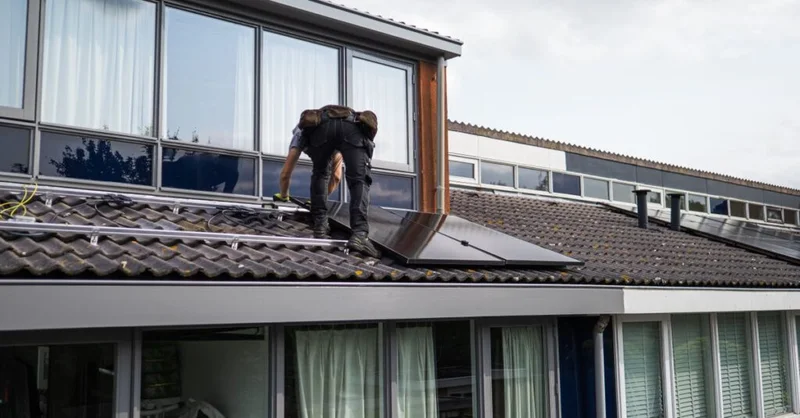
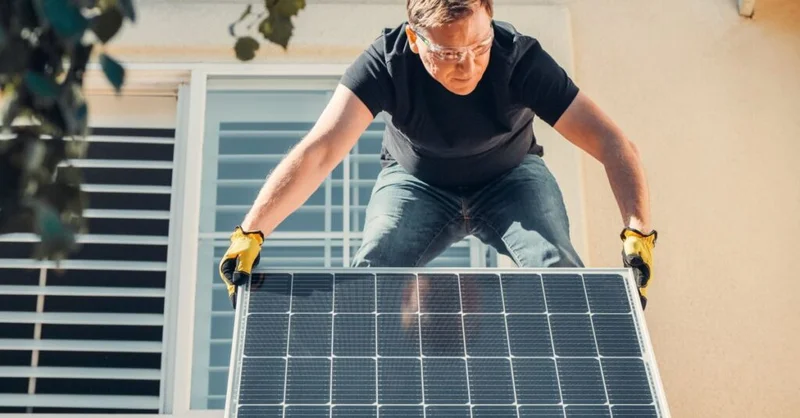
Installation: Many Tepto sets are plug-and-play, making them ideal for families without electrician appointments. Mounting options for balcony railings, flat roofs, sloped roofs, walls, or gardens are included. Two people can typically complete the installation of an 800-watt set in a morning. For sets with four modules, mounting structures, or storage, more time should be allocated, but the effort remains manageable.
A secure and stable installation is crucial, especially on balconies and rooftops. If you're unsure whether your structure can withstand wind, snow, or other elements, it's best to consult a professional.