
Maternal Anxiety: Symptoms, Causes, and Concrete Solutions
Maternal anxiety is that voice in your head that never stops. Learn about its symptoms, causes, and effective solutions to help you cope.

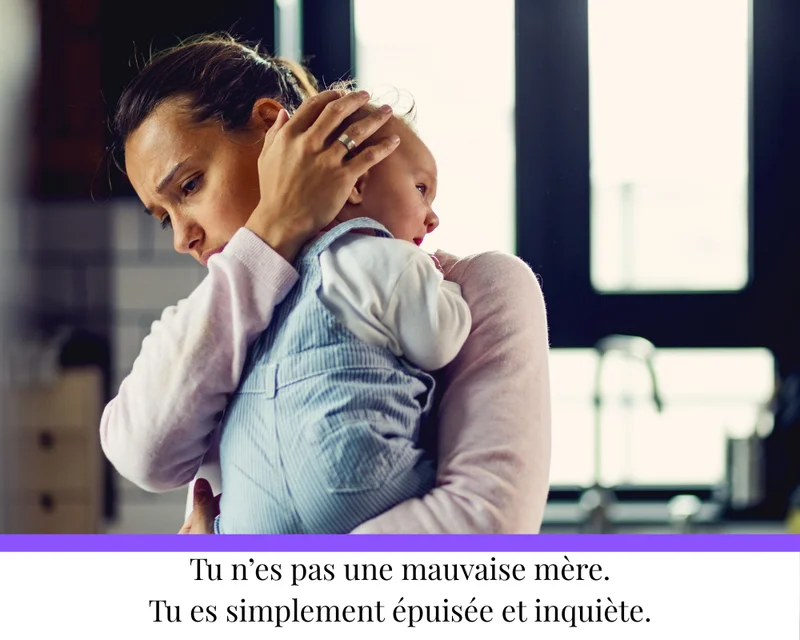
Maternal anxiety is that voice in your head that never stops. You check your baby's breathing three times a night. You panic when someone else holds them. You imagine catastrophic scenarios every time you get in the car. You wake up suddenly for no reason. And no one around you seems to truly understand the intensity of what you're experiencing.
If you're reading these lines with a tight heart, know one essential thing: you are not crazy. You are not a bad mother. You are not alone either. What you are going through has a name, it is documented, it is widespread, and most importantly, it is treatable. Here’s everything you need to know to put words to your experience and find help.
What is Maternal Anxiety Exactly?

First, let’s clarify one thing: feeling worried about your baby is completely normal. It’s even biological. But when this worry becomes overwhelming, constant, and paralyzing, we talk about pathological maternal anxiety.
As explained in the official document from the Canadian Psychological Association, anxiety is a natural reaction, and we all experience it when we feel threatened or in danger. However, you don’t need to be in danger to feel anxiety. Even the thought that something serious could happen to ourselves or our loved ones – especially our baby – can trigger anxiety.
And do you know what’s important? About 20 percent of pregnant women and new mothers suffer from anxiety and related disorders. One in five mothers. This is not an isolated case. It’s a massive phenomenon, just silent.
Maternal Anxiety is More Common Than Postpartum Depression
This is information that surprises many women. We hear about postpartum depression everywhere, but maternal anxiety is still taboo. Yet, the website Naître et Grandir clearly states: anxiety affects about three times more mothers in the postpartum period than depression, according to the results of a study conducted with 310 women, 6 to 8 weeks after the birth of their child.
Three times more. And yet, we hardly ever talk about it. It’s this silence that makes young mothers feel so alone in what they are experiencing.
Signs of Maternal Anxiety to Recognize
How can you tell if you’re simply going through a normal period of worry or if you’re facing real maternal anxiety? Here are the signals that should alert you.
Intrusive Thoughts, This Unknown Phenomenon


Do you find yourself imagining your baby falling, choking, or stopping breathing? Do you visualize accidents in detail? Do you tell yourself that you could accidentally hurt them? You are not becoming dangerous. You are experiencing what we call intrusive thoughts.
The magazine Slate, which relayed a New York Times survey, perfectly summarizes this phenomenon: "What if the baby chokes?", "What if they stop breathing?", "What if they fall out the window?" Shortly after the birth of her first baby in 2014, Crystal McAuley began having catastrophic thoughts about her child's health. This young mother had intrusive thoughts, meaning negative, unwelcome thoughts, or very disturbing images that seemed to come from nowhere.
These thoughts do not reflect who you are. They are a symptom. They happen to many mothers, especially when lack of sleep, stress, and responsibilities accumulate.
Constant Hypervigilance


This is probably the most exhausting symptom. You are on high alert 24/7. You jump at every noise. You check multiple times a night that your baby is still breathing. You can’t relax, even when the baby is sleeping peacefully.
The association Maman Blues, a French reference on maternal psychological suffering, describes this experience very precisely: these mothers are in a constant state of alertness, always watching their baby in fear that something might happen to them. They feel the need to be active, to be in constant motion as if there were a risk in resting, doing nothing, and allowing themselves to be penetrated by the question and reality of their child.
Impulse Phobia


This is probably the most terrifying and taboo symptom. You suddenly fear hurting your baby unintentionally. You imagine actions that you would never take. You avoid holding them near a window, bathtub, or balcony.
The May app, which specializes in postpartum support, is very clear on this point: these intrusive thoughts are not correlated with a risk of abuse, do not forget that. Impulse phobia sometimes disappears quickly when you gain confidence that you know how to take care of your baby.
So you can breathe: having these thoughts absolutely does not mean you will act on them. It’s actually the opposite – mothers who talk about them are the ones who love their child the most deeply.
Physical Symptoms of Maternal Anxiety

Anxiety is not only experienced in the mind. It also manifests in the body:
- Constant knot in the stomach
- Heart racing for no apparent reason
- Difficulty breathing, feeling of tightness
- Insomnia even when the baby sleeps
- Muscle tension (neck, shoulders, jaw)
- Loss of appetite or conversely anxious snacking
- Recurring headaches
- Night sweats or tremors
If you check several of these boxes, it’s not in your head. It’s your body telling you it needs help.
Why Does Maternal Anxiety Occur?
Several factors combine to create this anxious environment. Understanding what is happening will help you stop judging yourself.
Hormonal Changes

The sudden drops in estrogen and progesterone after childbirth destabilize your neurotransmitters. It’s purely chemical, and it affects all mothers to varying degrees.
Sleep Deprivation


No one can function normally with disrupted sleep for several months. Chronic sleep deprivation amplifies all negative emotions and disables your ability to think calmly.
Overwhelming Responsibility
A completely dependent being rests in your hands. Your brain, to keep you vigilant, overdevelops the circuits of worry. But sometimes, the system goes into overdrive.
Anxiety Sources on Social Media and Around You


Naître et Grandir emphasizes this well: everything a mother can read on social media, for example, or hear from a healthcare professional regarding her baby’s health is likely to increase her anxiety.
Alarmist forums, Facebook groups where the worst stories are shared, articles listing all possible dangers: all of this feeds the anxious machine. Filter what you consume.
Previous Traumas


A difficult childbirth, a previous miscarriage, perinatal grief, a complicated childhood, a history of anxiety or depression: all these elements increase the risk of maternal anxiety.
The poignant testimony of Clara, shared on the Maman Blues association's website, perfectly illustrates this experience: I hit rock bottom. I am experiencing postpartum depression, and it manifests as an anxiety disorder, a state of generalized anticipation anxiety, the fear of fear. The fear of fear. This terrible phrase describes so well what thousands of young mothers experience.
How to Calm Maternal Anxiety in Daily Life
Here are concrete paths that really help, starting with the simplest.
First Reflex: Dare to Talk About It


This is the most difficult and liberating step. Talk to your partner, a mom friend, your midwife, your family doctor. Putting words to it breaks the spell.
Naître et Grandir insists on this point: new mothers should talk more openly about the anxiety they experience. The new mom has an idealized image of motherhood and wants to match it. This prevents her from seeing that she can also experience some suffering or lead her to miss out on the happiness she can feel in the present moment.
Accept the Help Offered to You


You don’t have to carry everything alone. If someone offers to watch the baby for two hours so you can sleep, say yes. If someone offers to do the shopping, say yes. If someone offers to listen to you cry, say yes. Asking for help is not a weakness; it’s a maternal survival strategy.
Limit Sources of Anxiety
- Leave anxiety-inducing Facebook groups where the worst stories are shared
- Disable notifications from baby tracking apps if they stress you out
- Reduce scrolling on parenting accounts that make you feel guilty
- Pause conversations with people who amplify your anxiety
Establish Soothing Routines

- Heart coherence breathing: 5 minutes, 3 times a day
- Daily walks with the baby in a stroller or carrier
- Limit caffeine which amplifies physical symptoms
- Write a journal to express repetitive thoughts
- Guided meditation via apps dedicated to new moms
- Sleep whenever possible without feeling guilty about "doing nothing"
When Maternal Anxiety Requires Professional Help

Here are the signs that should prompt you to consult without delay, without guilt, without hesitation.
The Canadian Psychological Association clearly lists these moments: it’s time to seek help when we feel anxious, on edge, or worry a lot almost every day, notice that anxiety is really bothering us or that it interferes with our daily life, avoid places, activities, people, or situations that might trigger anxiety.
Specifically, consult if:
- Your anxiety prevents you from sleeping even when the baby sleeps
- You have daily intrusive thoughts that terrify you
- You avoid normal activities due to excessive fear
- You feel "disconnected" from your baby due to anxiety
- You feel despair, a sense of uselessness
- You have dark thoughts about yourself or the baby
- Your loved ones are worried about your condition
Essential Help Resources to Know
French National Line:
- Allô Parents Bébé: 0 800 00 34 56 (anonymous and free listening line specialized for new parents)
- 3114: national suicide prevention line, available 7 days a week, 24 hours a day, free and anonymous
Specialized Associations:
- Maman Blues: the French reference on maternal psychological suffering
- Pandora Project: specialized support in maternal mental health
- The Houses of the First 1000 Days: public support structures
Professionals to Consult First:
- Your private midwife (postnatal follow-up covers mental health)
- Your family doctor
- A psychologist specialized in perinatality
- A psychiatrist